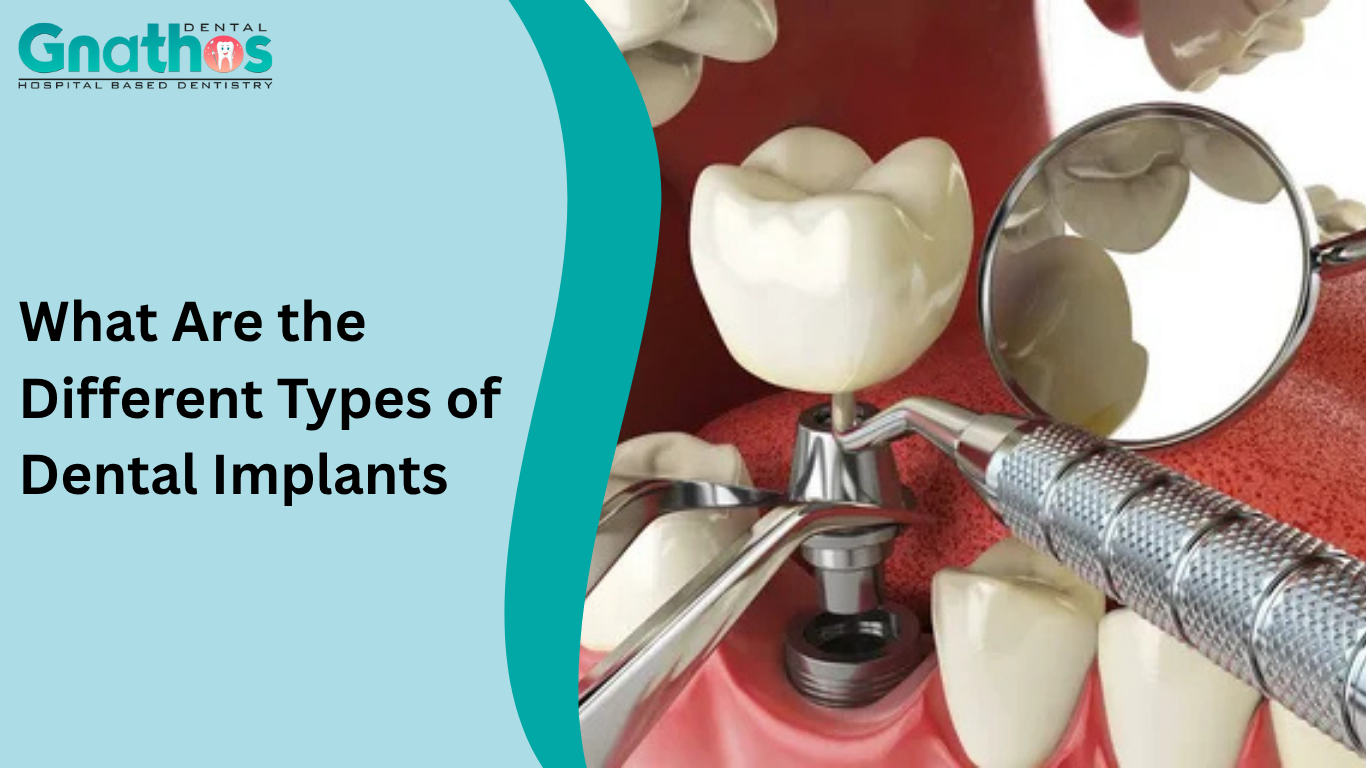
Dealing with tooth loss can be tough, and if you’ve been researching the best way to replace missing teeth, you’ve undoubtedly come across dental implants. They truly are the gold standard in tooth replacement—a game-changer that offers a permanent, stable, and natural-looking solution.
But when you start looking into them, you realize there’s more to it than just one type of screw. You might be wondering, “What Are the Different Types of Dental Implants?” and how do you know which one is right for you? It’s a fantastic question, and one that requires a deep dive into the technology, materials, and techniques used today. We’re going to explore the various Types of Dental Implants, breaking down the complex world of modern implantology so you can feel informed and confident when you speak to your specialist.
The Foundation: Understanding the Anatomy of a Dental Implant
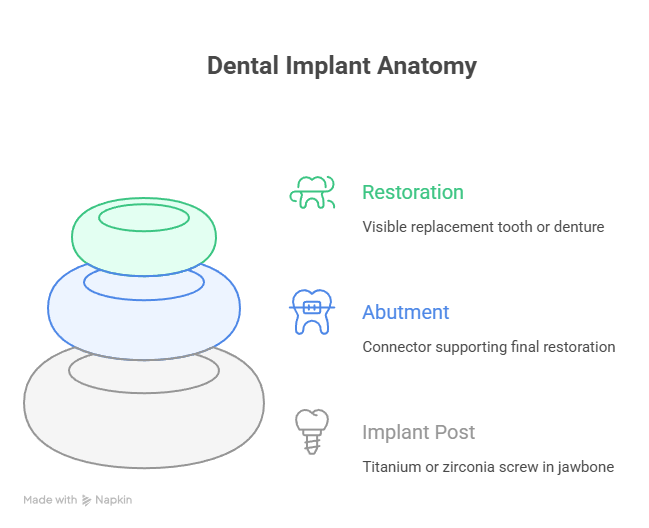
Before we categorize the different Types of Dental Implants, it’s helpful to understand what a dental implant is composed of. Every implant system, regardless of its type, has three main parts:
- The Implant Post (Fixture): This is the actual screw or root replacement, typically made of titanium or zirconia. It’s surgically placed into the jawbone and acts as a stable anchor. This is the part that defines the primary Types of Dental Implants.
- The Abutment: This is a small connector piece that attaches to the implant post. It extends above the gum line to support the final restoration.
- The Restoration (Prosthesis): This is the visible, replacement tooth, which can be a single crown, a multi-unit bridge, or a full denture.
The success of any implant relies on a process called osseointegration, where the bone fuses directly with the implant post. This is what provides the incredible stability and longevity that implants are famous for.
Classification of Dental Implants: The Major Types
The core answer to “What Are the Different Types of Dental Implants?” lies in the design of the post and how it interacts with the jawbone. There are two primary categories recognized by the American Dental Association (ADA), with modern dentistry often focusing on the first:
1. Endosteal Implants (In the Bone)
Endosteal implants are the most common type used today. The word “Endosteal” means “in the bone.” These implants are typically shaped like small screws, cylinders, or blades and are surgically placed directly into the jawbone.
- Screw-Type (Threaded) Implants: These are by far the most widely used and successful Types of Dental Implants. They are shaped like a small titanium screw. The threads on the screw increase the surface area for bone contact, leading to strong osseointegration. They are suitable for most patients who have adequate bone density.
- Cylinder Implants: These are hollow or solid cylinders that are also placed directly into the bone. While less common than screw-type, they function on the same principle of osseointegration.
Sub-Classification of Endosteal Implants (Based on Size/Width):
- Standard Implants: Used for most single-tooth replacements and typically for front teeth.
- Wide Platform Implants: Used for back teeth (molars) where the biting forces are much higher and a wider surface is needed for stability.
- Mini Implants (MDIs): These are much smaller in diameter (less than 3mm) and are primarily used for stabilizing a lower denture (overdenture). They are often a simpler, less invasive option, but they do not provide the same long-term stability as conventional implants for replacing individual teeth.
2. Subperiosteal Implants (On the Bone)
- What they are: “Subperiosteal” means “on the bone.” These implants consist of a metal framework that fits directly on top of the jawbone, just under the gum tissue. Posts attached to the framework protrude through the gums to hold the denture or bridge.
- When they are used: This was historically the main option for patients who couldn’t wear conventional dentures and had insufficient bone height for endosteal implants. Due to significant advancements in bone grafting, this type is rarely used today.
Categorization by Procedure and Technique
Beyond the basic design of the post, a crucial way to classify Types of Dental Implants is by the surgical technique and the timeline of the restoration. This is where modern implantology shines and offers personalized solutions.
1. Single-Stage vs. Two-Stage Implants
This classification refers to how the implant is placed in relation to the gum tissue:
- Two-Stage Procedure (Traditional): The implant post is surgically placed and then covered by the gum tissue. It is left to heal and osseointegrate for 3 to 6 months. A second, minor surgery is then performed to uncover the implant and attach the healing abutment and eventually the final crown. This offers a highly predictable outcome by fully protecting the implant during the critical healing phase.
- Single-Stage Procedure: The implant post is placed, and the abutment/healing cap is attached immediately, leaving it exposed through the gum tissue. This eliminates the need for a second surgery. It is often preferred in cases where the bone is very stable and predictable healing is expected.
2. Immediate Load Implants (“Teeth in a Day”)
- What they are: This refers to the technique where a temporary crown or bridge is attached to the implant post on the same day the post is placed. This is a massive draw for patients wanting to walk out of the Dental Implants in Hyderabad clinic with a complete smile.
- When they are used: This is only possible if the implant achieves a very high level of primary stability (tight fit) in the bone immediately after placement. It is most commonly used for replacing an entire arch of teeth, such as the All-on-4 or All-on-6 systems. The load applied must be gentle and precise to avoid micro-movements that could jeopardize osseointegration.
3. All-on-4 / All-on-6 (Full-Arch Restoration)
This is one of the most innovative Types of Dental Implants for patients missing an entire arch of teeth.
- The Concept: Instead of placing an implant for every missing tooth, a full arch of teeth (a permanent denture or bridge) is supported by just four to six strategically placed implants. The back implants are often placed at an angle to maximize contact with the densest bone, avoiding the need for extensive bone grafting in the sinus area.
- Advantages: Fewer implants are needed, reducing the cost and complexity. It can often be done with immediate loading, meaning a patient can receive functional, fixed teeth in a single visit to the Dental Implants in Hyderabad specialist.
4. Zygomatic Implants (For Severe Bone Loss)
- What they are: These are extremely long implants that are anchored into the zygomatic bone (cheekbone) instead of the jawbone.
- When they are used: These are reserved for patients who have suffered extreme bone loss in the upper jaw (maxilla), making standard implant placement impossible without major, time-consuming bone grafting procedures. This technique offers a solution for patients with severe bone atrophy who want fixed teeth.
Categorization by Material: Titanium vs. Zirconia
While titanium has been the undisputed champion for decades, zirconia is a newer material that offers a compelling alternative and is changing the conversation about Types of Dental Implants.
| Feature | Titanium Implants | Zirconia Implants |
| Biocompatibility | Excellent; long history of success. | Excellent; metal-free, hypoallergenic. |
| Strength | Exceptional; unmatched fracture resistance. | Very high; ceramic material is extremely hard. |
| Aesthetics | Metal color; may be visible in patients with thin gums. | White/tooth-colored; superior aesthetic profile. |
| Design | Two-piece system (implant + abutment). | Often a one-piece system (implant and abutment are fused). |
| Usage | Gold standard for virtually all procedures. | Growing rapidly; ideal for metal-sensitive patients. |
Many patients seeking a holistic approach or concerned about metal sensitivity will often inquire about the all-ceramic Types of Dental Implants (Zirconia) at a modern Dental Implants in Hyderabad facility.
The Importance of the Specialist
Ultimately, the decision of “What Are the Different Types of Dental Implants and which one is right for me?” is made by a highly qualified specialist. Choosing a reputable Dental Implants in Hyderabad clinic with an experienced implantologist is the single most important factor in your success.
A specialist like Dr. Suresh PL will use a methodical, diagnostic approach:
- 3D Imaging (CBCT Scan): To assess the exact quality, quantity, and density of your jawbone, as well as the location of nerves and sinuses.
- Case Planning: To determine the ideal Types of Dental Implants (size, length, and material) and their precise positioning to achieve maximum stability and avoid complications.
Surgical Expertise: To perform the placement with precision, often using computer-guided surgery techniques for optimal results.
Summary
The field of implantology offers a fantastic variety of Types of Dental Implants to address nearly every scenario of tooth loss, from a single missing tooth to an entire arch. Whether it’s the standard, time-tested Endosteal Implants, the advanced Zirconia options, or the innovative All-on-4 system, there is a path to a restored, confident smile. The best implant for you is not a fixed choice but a personalized solution based on your bone density, health status, and aesthetic desires.
To navigate these options and ensure the highest chance of success, it is vital to consult with a highly experienced implant specialist. Professionals like Dr. Suresh PL at a leading Dental Implants in Hyderabad facility are equipped with the expertise and technology to accurately diagnose your needs and recommend the optimal treatment plan. To take the next step toward a stable, permanent smile. Your journey to a full, functional smile is waiting!
Frequently Asked Questions (FAQs):
Q1. Is a dental implant procedure painful?
No. The implant placement surgery is performed under local anesthesia, so you will feel no pain. Some mild soreness or discomfort is common for a few days afterward, which is easily managed with prescribed or over-the-counter pain medication.
Q2. How long does the entire implant process take?
For a single standard implant, the process can take 4 to 9 months from the initial surgery to the final crown placement, allowing for the 3–6 month osseointegration period. Immediate load options (like All-on-4) can provide teeth in a day, but the full healing of the bone still takes several months.
Q3. How do I clean and care for my dental implants?
Implants require the same care as natural teeth: regular brushing (twice a day), flossing (special implant floss or tools are recommended), and routine check-ups and professional cleanings with your Dental Implants in Hyderabad specialist. While the implant itself can’t get a cavity, the surrounding gum tissue can get infected (peri-implantitis).
Q4. What is the difference between titanium and zirconia implants?
Titanium implants are metal-based and have a long record of durability and success. Zirconia implants are metal-free, tooth-colored, and ideal for patients with metal allergies or those seeking a more aesthetic option.
Q5. What are the different types of dental implants?
The main types of dental implants are Endosteal implants (placed in the jawbone) and Subperiosteal implants (placed on the bone under the gum). Modern dentistry also includes advanced options like All-on-4 implants, Zygomatic implants, and Mini implants, depending on individual needs and bone structure.